
As part of efforts to reduce the environmental impact of packaging materials, the use of recycled materials in the production of packaging films is becoming increasingly important. With our innovative polyolefin eco-friendly films featuring a high recycled content—certified to PCR (post-consumer recycled) and PIR (post-industrial recycled) standards—we are already practicing resource conservation, waste reduction, sustainability, and active environmental protection. The PCR and PIR films are highly transparent, brilliant, tear-resistant, and offer excellent heat-sealing and shrink properties as well as outstanding sealing capabilities—without compromising on quality or appearance.
What is PCR film?
The term PCR stands for “post-consumer recycled” or “post-consumer recyclate.” PCR is material recovered from plastic waste in the recycling cycle that is collected and recycled after being used by consumers. This plastic waste is collected at specialized recycling facilities, cleaned, and processed into high-quality pellets. These pellets are then incorporated into the production of new packaging films. Due to variations in quality, the use of this material poses a challenge for the waste management sector, which is continuously being improved. PCR recycled material may exhibit slight cloudiness, as the source material is often more heavily contaminated than industrial waste—however, modern recycling processes are increasingly minimizing this effect.
What is PIR film?
PIR stands for “post-industrial recycled material.” A certain proportion of PIR is sourced from industrial plastic waste generated by businesses, industry, and commerce and recycled into granules. This plastic waste, which is generally very pure, is used in part to produce new “ films ” and thus makes an important contribution to increasing recycling rates. PIR recyclate offers consistent quality, high transparency, and stable material properties, often comparable to virgin material.
Which is better—PCR film or PIR film?
Both film types are technically superior and meet the requirements for protection and presentation. PIR fine-shrink films are preferred when maximum visual brilliance and consistent processing characteristics are required—such as for high-quality product packaging in the cosmetics industry. PCR film, on the other hand, is the preferred choice when a sustainable brand image is a priority or when legal requirements regarding the recycled content in film packaging must be met. The choice therefore depends on the specific application and requirements.
The Benefits of Recycled Films Made from PCR and PIR
The use of PIR and PCR recycled materials in packaging films offers numerous advantages that positively impact the sustainability of the product life cycle while ensuring the highest quality and brilliance.
Conservation of Resources and Waste Prevention
The use of recycled materials reduces the need for new raw materials and limits the use of fossil fuels required to produce new materials. The use of PIR directly reduces waste volumes during production. This helps conserve natural resources and returns recyclable plastic materials to the production cycle.
CO₂ Reduction and Energy Savings
The use of PCR and PIR materials reduces the consumption of fossil raw materials, which significantly lowers CO₂ emissions in the production chain. The production of recycled films generally requires less energy than the manufacture of new plastic films from crude oil.
Promoting the Circular Economy
By using recycled materials, we close the material cycle, conserve natural resources, and reduce plastic waste. Reusing recycled materials to produce new packaging maximizes the lifespan and utility of resources—and ensures that less waste ends up in landfills or the environment. PCR film can be up to 100% recyclable, making it an environmentally friendly alternative to conventional packaging materials.
Quality and performance at the highest level
Environmentally friendly packaging films made from PCR and PIR offer high quality and performance comparable to that of conventional shrink films. Modern recycling processes enable the production of polyolefin fine-shrink films with excellent mechanical properties and barrier protection. Despite their high recycled content, the films films retain their brilliant transparency and showcase packaged products to their best advantage.
Customer Loyalty and Brand Promotion
Environmentally conscious consumers are increasingly looking for sustainable products and packaging. Companies that use eco-friendly packaging film made from PCR and PIR plastics can showcase their commitment to the environment. This strengthens customer loyalty and promotes a positive brand image—a key advantage in a market where sustainability is becoming increasingly important to customers.
Why Packaging Film Remains Indispensable
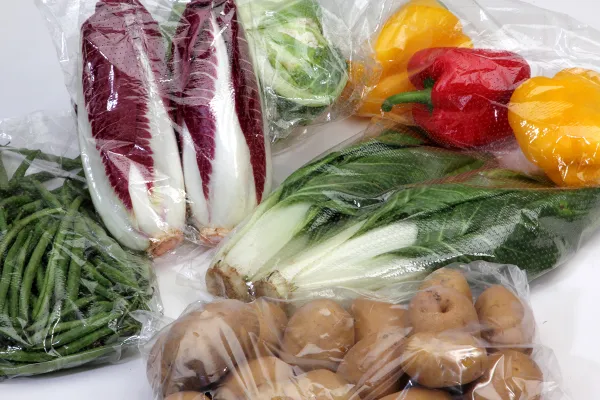
The benefits of high-quality packaging films are particularly evident in the food industry. Transporting perishable goods such as fruits and vegetables without adequate protective packaging is not environmentally friendly. Soft, delicate, and ripe fruits such as raspberries, strawberries, grapes, tomatoes, lettuce, bell peppers, and broccoli benefit from protective packaging—otherwise, the proportion of products that would have to be discarded due to damage even before sale would be many times greater.
According to the German Packaging Institute (dvi), food packaging accounts for only about 0.7 percent of the total carbon footprint of European consumers. The ecological footprint of a packaged food product is about 16 to 30 times larger than the footprint of the packaging alone. Product packaging for fresh foods extends quality, freshness, and shelf life by days, weeks, and in some cases even months, thereby significantly improving the ecological footprint.
Currently, approximately 10.6 million metric tons of food end up in the trash in Germany, Austria, and Switzerland. Further increasing this amount due to a lack of packaging and the resulting damage runs counter to the goal of reducing our ecological footprint. In Germany, approximately 99.4 percent of all collected plastic waste was recycled as early as 2019—and this percentage is steadily increasing. With recycled films that contain a certified percentage of post-consumer recycled (PCR) material from the recycling loop, the packaging industry is taking the next step toward a circular economy.
An Overview of Our Line of PIR and PCR Fine-Shrink Films
There are two grades of recycled material: PIR (films ) and PCR (films). All polyolefin shrink films offer excellent sealing and shrinkage properties, high mechanical strength, and are 100% food-safe and 100% recyclable in the LDPE04 recycling loop. High-quality polyolefin fine-shrink films are available in various thicknesses, typically between 10 and 30 micrometers, with shrinkage rates of up to 88%.
PIR—films —Post-Industrial Recyclate
RecyUse
Contains approximately 50% recycled PIR. A polyolefin fine-shrink film that is highly transparent with a high-gloss finish, high mechanical strength, and excellent sealing and shrink properties.
RecyUse
Contains approximately 50% recycled PIR. A low-temperature film designed for very high cycle rates, highly transparent, with a brilliant, glossy finish and hot-slip properties, as well as excellent sealing and shrinkage characteristics.
RecyUse
Contains approximately 50% recycled PIR. A highly transparent polyolefin fine-shrink film designed as a cross-linked multilayer material for very high cycle rates of up to 250 cycles per minute, offering high mechanical strength.
RecyUse
All-purpose anti-slip film containing approximately 50% recycled PIR. Highly transparent and glossy, with an extremely low coefficient of friction—perfect for products that must not slip.
PCR—films —Post-consumer recycled material
BF-RecyUse Circular E-PCR30
Approx. 30% certified PCR recycled content. Ideal for lightweight packaging applications requiring high flexibility and versatility.
BF-RecyUse , Circular X-PCR30
Approx. 30% certified PCR recycled content, cross-linked. Premium PCR film with exceptional strength and excellent shrink properties.
BF-RecyUse Circular S-PCR30
Approx. 30% certified PCR recycled content. The multifunctional PCR film for very high cycle rates—ideal for lightweight, high-performance applications on high-speed packaging lines.
BF-RecyUse , Circular E-PCR50
Approx. 50% certified PCR recycled content. An exceptionally durable packaging solution for high-demand product packaging.
BF-RecyUse , Circular X-PCR50
Approx. 50% certified PCR recycled content, cross-linked. Highly transparent PCR film with a high-gloss finish, cross-linked and electron-beamed, featuring extremely high seal strength and a shrinkage rate of up to approx. 88%.
BF-RecyUse Circular S-PCR50
Approx. 50% certified PCR recycled content. For more demanding high-performance applications requiring maximum sustainability and outstanding sliding properties.
Delivery Options and Features
All of the recyclable films in our line of organic and eco-friendly films are multilayer films and offer a wide range of packaging options and features:
- Forms of Supply: All films are available as flat or semi-tubular film.
- Perforation: All films are available with hot-needle perforation in type P1 (small) or type P2 (large).
- ESD Equipment: All films are available with ESD equipment for antistatic products such as electronic components, printed circuit boards, etc.
- Printing: All films can be printed using up to 10 colors via gravure printing.
- Film cores: All films are available with either a 76-mm or 152-mm film core.
By reducing film thickness while maintaining the same—or, in most cases, even better—quality, you can achieve additional savings on your packaging. Since all PCR-films and PIR-films films are extremely clear, brilliant, and feature a high-gloss finish, your products will have an eye-catching appearance that maximizes sales potential.
Sustainable Packaging with Recycled Films from Schlichter GmbH
With our BF-RecyUse recycling films, you’re making the best choice for a sustainable packaging solution without compromising on quality. The combination of a high PIR or PCR recycling content, state-of-the-art manufacturing technology, and our proven standards makes the BF-RecyUse —films —a forward-looking solution for your business.
Thanks to our extensive inventory and in-house film manufacturing, we are generally able to deliver quickly—even for last-minute orders. Companies that rely on eco-friendly packaging film made from PCR and PIR plastics make a valuable contribution to protecting the environment and demonstrate their commitment to a more sustainable future.
Please contact us—we’ll provide you with personalized, objective, and non-binding advice on the many options for sustainable packaging. We’d also be happy to provide you with samples.