
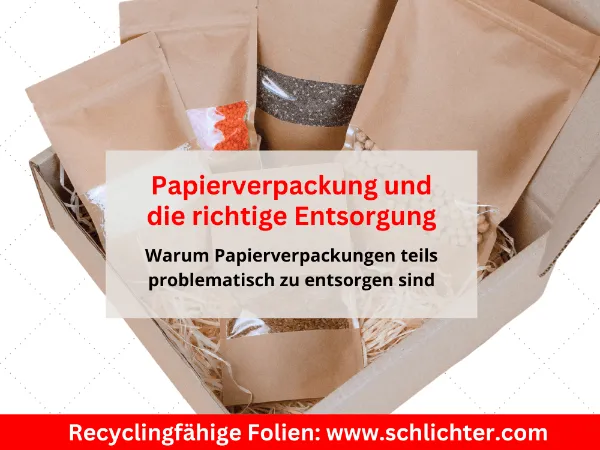
End customers often want to do more to protect the environment and, in good faith, look for paper packaging. We’d like to discuss here why this can often be problematic when it comes to disposal.
Paper packaging in the fresh food section is harmful to the environment. A provocative but accurate assertion. As reported on freshplaza.de reports, Shay Zeltzer—a postharvest specialist and founder of Postharvest Hub Ltd.—is also shocked by the greenwashing surrounding the increased use of paper packaging in the fresh produce sector following his visit to Fruit Logistica in Berlin.
Why Paper Packaging Can Sometimes Be More Problematic
Contrary to popular belief, coated paper packaging is, in some cases, less sustainable than other packaging options due to various factors, as it can be more difficult to dispose of. This is mainly due to the coating materials used and the resulting disruption to the recycling process.
Many paper packaging materials are coated with plastics or waxes to make them water- and grease-resistant. These coatings are often necessary to make the packaging suitable for certain foods, particularly those that contain moisture or fat. However, these additional materials make recycling more difficult, as the paper and plastic or wax would have to be separated—a process that is technically complex and costly. The lamination and impregnation of paper packaging—which are necessary for sealing and use in the fresh food sector—are also counterproductive in terms of compostability; these materials are not suitable for composting. It is far simpler to properly dispose of packaging films through the recycling system.
Paper composite packaging—it looks eco-friendly, but it isn't
The situation is even more problematic with so-called paper-composite packaging. In these cases, the packaging consists of paper and, in some cases, plastic. Consumers very often dispose of it incorrectly. Even with the best intentions to separate the materials—which is already quite a challenge and requires a high level of awareness—the laminations and impregnations cannot be removed. The result: paper ends up in the plastic waste, or plastic ends up in the paper recycling bin. In both cases, disposal cannot be carried out correctly from an environmental perspective. Consumers believe they are making a positive contribution because of the paper content—but unfortunately, they are far off the mark.
Limited recyclability
Because of the coated materials, many of these paper packaging items cannot be processed through the standard paper recycling process. However, since they contain paper, they also do not belong in the “yellow bin,” from which recyclable PCR material can be recovered. The coatings contaminate the paper fibers, which reduces the quality of the recycled paper. In many cases, this packaging must therefore be disposed of as residual waste, leading to increased environmental impact.
Increase in Environmental Impact
If coated paper packaging is not recycled and is instead incinerated or sent to landfills, it contributes to environmental pollution. Incineration can release harmful emissions, while landfilling causes long-term problems due to the decomposition of the materials, including the release of methane gas and other harmful chemicals.
Energy Consumption and Carbon Footprint of Paper Packaging
The production of paper bags consumes more energy than the production of plastic. The U.S. Department of Energy (DOE) has determined that the energy required to produce one metric ton of paper is approximately 5,162 kWh (for artisanal paper weighing about 200–250 grams per square meter). In contrast, one metric ton of LDPE film (thickness approx. 20–30 microns) requires only half that amount of energy. Paper production also requires a significant amount of water.
Another issue is the need to laminate and impregnate paper packaging so that it can be sealed and used for fresh food products. This is counterproductive and has a negative impact on compostability. These materials are not suitable for composting. Increased deforestation is another problem. Forestry alone will not be sufficient to meet the rising demand for paper packaging if this trend continues.
But paper is also less environmentally friendly when it comes to transportation and the associated CO₂ emissions. This is because paper is heavier and bulkier than plastic. As a result, it has a larger carbon footprint during shipping: A typical plastic bag weighs 0.0276 grams per square meter, depending on its thickness. A paper bag with the same tear resistance as a plastic bag weighs about 60 grams per square meter. If tear resistance is used as a measure, paper is 2,000 times heavier than the equivalent LDPE bag.
How should coated paper packaging be disposed of?
The disposal of coated paper packaging also depends on local recycling regulations and the capabilities of existing recycling facilities. Consumers should check the specific recycling guidelines for their municipality or state. Some regions have special recycling programs for coated paper packaging, while in other regions, such materials should be disposed of as general waste.
If coated paper packaging can be recycled, it should be cleaned of food residue before disposal to minimize contamination of the recycling stream. If the local recycling program does not accept coated paper packaging, it may be helpful to look for alternative disposal or recycling options—there are specialized recycling centers that handle coated paper packaging more effectively.
The Solution: The 3Rs—Reuse, Reduce, and Recycle
The solution may lie in the so-called 3Rs: “Reuse, Reduce, and Recycle”—that is, reuse, reduction, and recycling. When plastic-based packaging is used in a way that reduces package sizes and thicknesses, avoids excess packaging, and prioritizes sustainable reuse and recycling, plastic packaging is more sustainable than so-called paper packaging and paper composite packaging.
Schlichter GmbH has fully embraced this philosophy for many years and has long been committed to environmentally friendly packaging solutions.
The sustainable, reduced-thickness, high-performance films made from recycled materials—films —in the areas of polyolefin fine-shrink films, BOPPfilms , and bio-based and eco-friendly films are the result of these years of effort. Implementing a sustainable packaging strategy that equally addresses environmental protection and the requirements for freshness and food safety is a key priority in the further development of films at Schlichter GmbH.
Packaging films that are 100% recyclable in the LDPE04 recycling loop
Unlike coated paper packaging, packaging films can be easily disposed of through the recycling system and in the “yellow bin.” This material can be used to create new films and new products, significantly reducing the consumption of raw materials.
Schlichter GmbH has been committed to environmentally friendly packaging solutions for years. Our Bio- and Umwelt-films s are made from a certified proportion of recycled plastic and are highly transparent, have a brilliant appearance, and reliably protect the product. These packaging films feature high mechanical strength and excellent sealing and shrink properties. films s are 100% food-safe and 100% recyclable in the LDPE recycling stream. Many additional properties make this film suitable for virtually any application, meeting the criteria for sustainability and packaging safety while delivering optimal packaging results.
Would you like to learn more about our wide range of films? Schlichter GmbH is happy to provide you with personalized advice.Please write to usorgive us a call.